
Tactile Sensing for Wearable Gait Monitoring: The SENSOLE Case Study
For people living with peripheral neuropathy, gait and foot loading are not just biomechanical signals. They are part of a much bigger clinical picture linked to comfort, confidence, safety, and long-term health. The SENSOLE project was conceived as a platform for tactile sensing for wearable gait monitoring, helping move care beyond occasional clinic visits and toward continuous insight in everyday use. The project consortium partners included Sensars, a leading Swiss neuroprosthetics company with a patented intra-neurostimulator for highly selective peripheral nerve stimulation to restore sensory loss; a UK-based company that harnesses quantum technology to establish a new generation of smart materials with a vast dynamic range, high sensitivity and control to provide real-world energy efficient pressure and shear sensing; and Elitac Wearables, a Dutch SME that supports companies in the development of wearable electronics for the health, safety/professional and sports sectors and specializes in integrating electronics and textiles, with a particular focus on haptic feedback applications and sensor integrations.
For Touchlab, this project was a chance to apply tactile sensing expertise in a new domain. Instead of adding touch to robotic fingertips or grippers, the challenge was to build a thin, flexible sensing layer that could operate inside footwear while still delivering useful data about contact, movement, and load distribution.
PROJECT BRIEF | CONSORTIUM & FUNDING |
| SENSOLE brought together Sensars, Touchlab, Quantum Technology Supersensors (QTSS), and Elitac Wearables. The project was structured as a Eurostars and Innovate UK collaboration, combining neuroprosthetics, tactile sensing, smart materials and wearable electronics expertise. That mix mattered because the challenge sat at the intersection of advanced materials, highly performance continuous monitoring, system integration and future therapy support. |
The Challenge: Engineering Tactile Sensing for Wearable Gait Monitoring
SENSOLE project had to solve a harder problem than a conventional smart insole. It was not enough to capture a few pressure points. The system needed to be wearable, low profile, robust, and comfortable, while still producing data that could support clinical interpretation and future therapy decisions.
That created several engineering hurdles at once:
Coverage vs. simplicity: deciding how many sensels were needed to capture meaningful plantar information without making the design fragile, expensive, or difficult to manufacture.
Signal quality vs. wearability: preserving reliable readings despite bending, neighbouring sensel influence, air gaps, and the realities of an in-shoe environment.
Integration vs. comfort: combining sensing, electronics, power, and inertial measurement without creating bulky regions or hard features that would be uncomfortable for the wearer.
Our Approach: A Modular Architecture for High-Resolution Data
Touchlab's approach started with sensor architecture. Early design work explored both lower-density and higher-density layouts, including 15 normal + 1 triaxial sensing array configuration, with careful attention to key plantar regions and the addition of a heel shear/pressure sensel. The aim was not simply to add more sensing channels, but to place sensing where it would matter most while keeping the structure thin and practical.
Rather than embedding everything directly into the insole, the project also favoured a flatter sensing layer inside the shoe and a separate electronics module above the ankle that include IMU, BLE and wireless battery low power continuous operation. This reduced mechanical complexity, improved serviceability, and aligned the hardware more naturally with IMU placement for gait analysis.
 |  |
Insoles prototype prior assembly
The resulting prototype combined insole taxels with a 6-axis IMU and a modular electronics stack for Bluetooth Low Energy communication, power management, analogue front-end readout, and left/right adapter connectivity. Together, this created a compact system able to stream both plantar and motion data in real time.
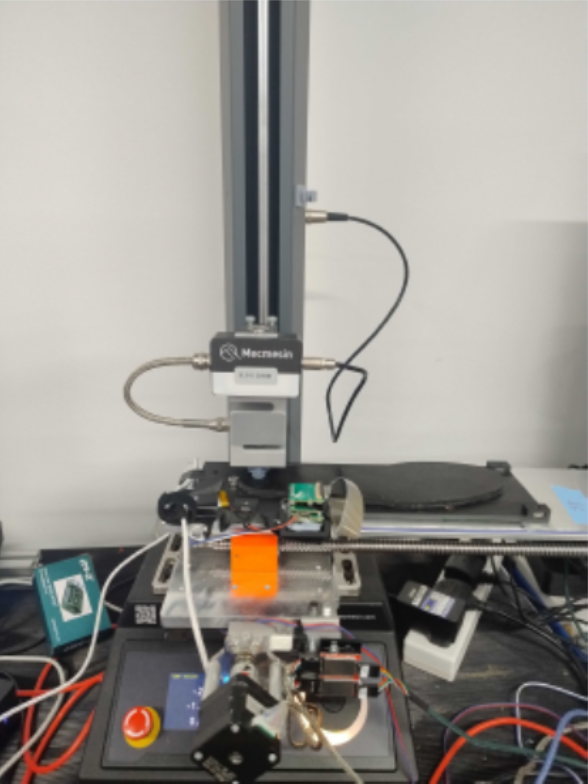 |  |
Characterisation setup used to evaluate insole behaviour under controlled loading conditions
Validation: Characterising Insole Behavior Under Dynamic Loading
To move beyond concept work, the team characterised both normal-force and shear-related behaviour. Pressure evaluation was carried out on a modified Mecmesin OmniTest 2.5, with individual taxels repeatedly compressed through controlled loading profiles while force data from the test stage was compared against sensor output.
Shear-related evaluation used a UR5e arm to apply normal and angled actuations at 15, 30, and 45 degrees in positive and negative X and Y directions. This gave the project a structured way to assess directional loading response rather than focusing only on vertical pressure.
Just as importantly, the work surfaced the practical integration issues that define whether a wearable sensor system is genuinely usable: calibration matching, low-force behaviour, BLE streaming, connector alignment, routing of the sensor film, and mechanical reliability at the film-to-electronics interface.

Typical insole taxel response under dynamic loading during bench testing
The Result: From Bench Testing to Clinical Gait Applications
SENSOLE project demonstrated how Touchlab's tactile sensing can be adapted into a clinically relevant wearable format. Through iterative insole design, modular electronics, wireless data streaming, and structured bench characterisation, the project established a working prototype platform for gait monitoring and future therapy support. With the system currently undergoing clinical trials with our partners.
The project also reinforced a broader lesson: bringing touch into healthcare wearables is not only about sensor performance in isolation. It is about packaging, comfort, calibration, robustness, and system integration. In other words, success depends on turning tactile sensing into something a patient can actually wear and a clinician can meaningfully use.
As Touchlab continues to extend touch sensing beyond robotics, SENSOLE project stands out as a strong example of how the same core capabilities-thin form factor, flexibility, spatial sensing, and real-time data-can open up new possibilities in medical and rehabilitation technology.
Ready to integrate tactile sensing into your next wearable?
At Touchlab, we specialize in moving advanced sensing technology out of the lab and into the real world. Whether you are developing medical devices, industrial wearables, or next-generation robotics, our team can help you navigate the complexities of tactile sensing for wearable gait monitoring and beyond.

